
AEO vs GEO vs SEO: all three aim to make your brand discoverable, but each targets a different result. SEO earns rankings in search results. Answer Engine Optimization (AEO) earns the direct answer. Generative Engine Optimization (GEO) earns a mention or recommendation inside AI-written responses. This guide explains how they differ and which to prioritise.
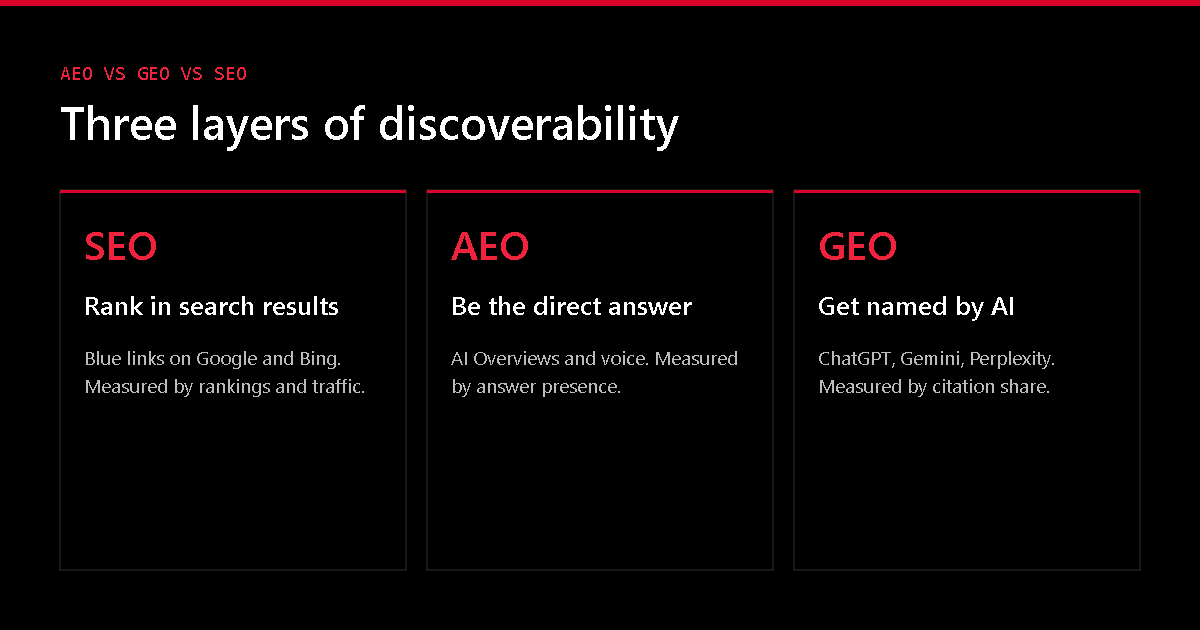
AEO vs GEO vs SEO at a glance
| Discipline | Goal | Where you appear | How you measure it |
|---|---|---|---|
| SEO | Rank pages in search results | Google and Bing blue links | Rankings, organic traffic |
| AEO | Be the direct answer | AI Overviews, voice assistants, answer engines | Answer and snippet presence |
| GEO | Be named and recommended | ChatGPT, Gemini, Perplexity, Copilot responses | Citation share across AI platforms |
What is SEO?
Search Engine Optimization (SEO) improves how pages rank in traditional search results through relevance, technical health and authority. It remains the foundation of AEO and GEO, because many AI systems retrieve information from pages that search engines can already crawl and trust.
What is AEO?
Answer Engine Optimization structures content so answer engines can lift a clear response from your page. It relies on question-led headings, concise definitions, FAQs that match real queries and valid structured data.
What is GEO?
Generative Engine Optimization influences how generative AI describes, compares and recommends your brand. It relies on clear entity signals, consistent facts across the web, evidence AI can reuse, and LLM search visibility work so that models can retrieve your content.
How AEO, GEO and SEO work together
They are layers, not rivals. SEO makes your pages findable. AEO makes the answers on those pages easy to extract. GEO makes your brand the one AI chooses to name. A page that follows all three is crawlable, answers a specific question directly, and sits within a consistent brand entity.
Which should you prioritise?
- Start with technical access. If AI crawlers or search bots cannot reach your site, nothing else works. An AI search audit checks this first.
- Choose AEO if buyers ask direct, factual questions in your category.
- Choose GEO if buyers ask AI for comparisons and vendor shortlists.
- For e-commerce, add AI product search visibility so products can be recommended in shopping answers.
- Keep SEO running. It supports both AEO and GEO.
How to measure progress
Test the same set of real buyer questions on each AI platform every month. Record whether your brand is mentioned, whether your site is cited, and which competitors appear. Our guide to 10 steps for AI search visibility covers this baseline, and our 12-point agency scorecard helps you evaluate providers.
Frequently asked questions
What is the difference between AEO and GEO?
AEO aims to make your content the direct answer to a question. GEO aims to get your brand mentioned and recommended inside AI-generated responses, comparisons and shortlists.
Does AEO or GEO replace SEO?
No. SEO remains the foundation, because AI systems often draw on pages that are crawlable and trusted. AEO and GEO build on top of it.
Which is better for B2B brands, AEO or GEO?
Most B2B brands need both: AEO for factual questions during research and GEO for the vendor shortlists buyers request from AI assistants.
How long do AEO and GEO take to show results?
Usually weeks to months, depending on your current entity signals, content quality, crawler access and competition. No provider can guarantee placement inside a third-party AI system.
Want to know where you stand? See AEO and GEO pricing plans or contact Netcloud India for a free strategy call. Further reading: Google Search Central: AI features and your website.

 Kaushik Bose(https://www.linkedin.com/in/kaushikboseindia)